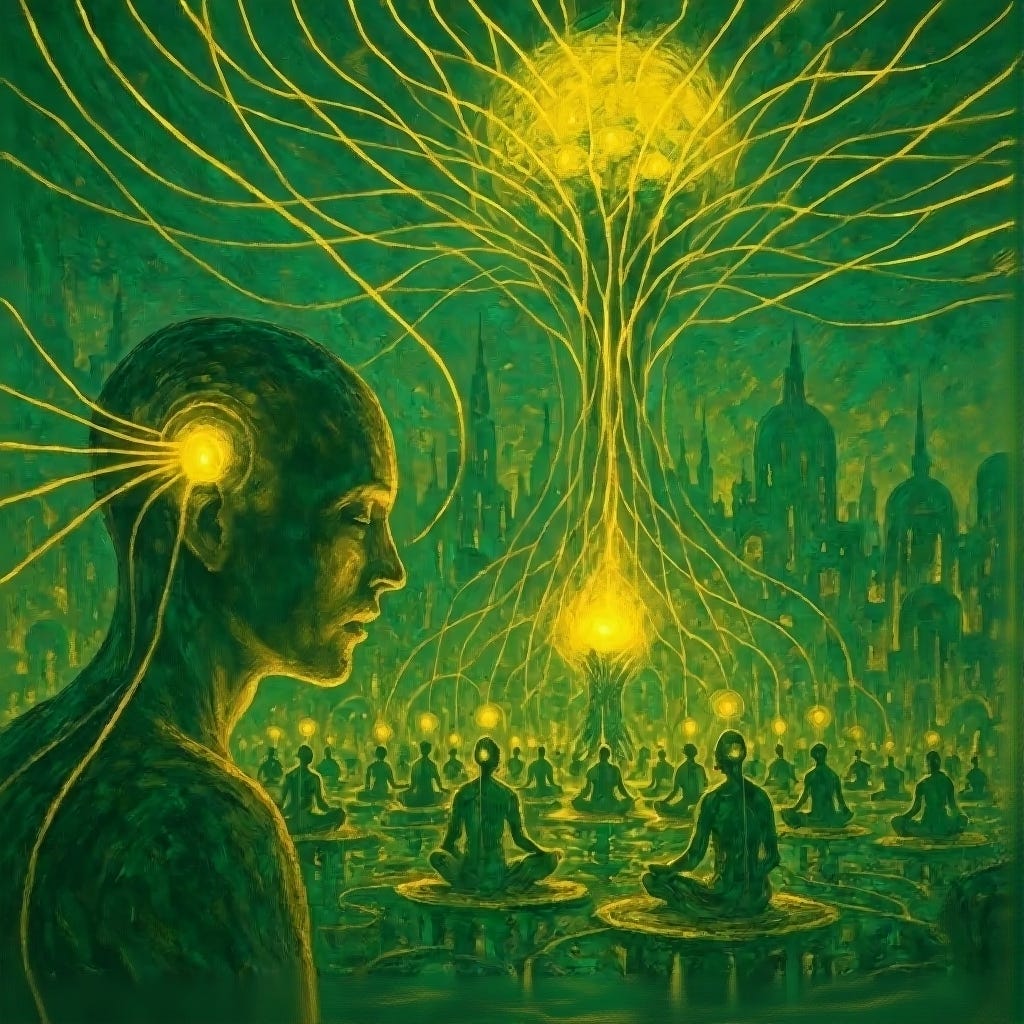
You see a red car tearing down the asphalt. But what does it mean to see the car?
In the beginning was the light — photons dashing toward you at many hundreds of millions of miles per hour. Like a knife slicing through butter, they pass through the cornea and lens, which bend them and bring them to a focus at the back of the eye. There, in the dark chamber of the retina, photopigments inside rods and cones transmute light into electricity. And then it starts.
One after another, ion channels in their membranes begin to close, making the cells more negative inside and reducing the amount of glutamate they release into the synaptic cleft. Horizontal cells enter the stage, their neurotransmitters heightening the contrast between neighboring signals as they pass from photoreceptors to bipolar neurons. Farther downstream, amacrine cells take up the signal, amplifying some impulses, suppressing others, and holding others back before they reach the ganglion neurons.
These in turn gather what remains and convert it into action potentials, the first true electrical pulses of vision. Their axons braid together into the optic nerve and carry the signal out of the darkness of the eye. At the optic chiasm, fibers from the nasal half of each retina cross to the opposite side, so that information from the left half of the visual field travels toward the right hemisphere and vice versa. Most of these impulses stop briefly in the lateral geniculate nucleus of the thalamus, where the stream is organized and relayed through the optic radiations to the primary visual cortex at the back of the skull. There, layer by layer, the brain extracts color, edges, depth, and motion, binding them into the red car tearing down the asphalt.
And here lies the enigma. How does the brain bind features processed by separate neural circuits into a single conscious experience? There is no hidden observer seated behind the eyes, watching the movie flash onto the screen. There are only neurons firing, a labyrinthine machinery of cold chemical reactions. Yet from this machinery emerges reality: luminous, alluring, palpable, immediate.
This is the binding problem. We can follow the signal from photon to photopigment, from retina to thalamus, from thalamus to cortex. We can watch the brain dismantle the scene and assemble it again. But the final crossing, from information to experience, remains hidden. Somewhere inside the skull, electricity becomes a world.
Which raises the question: what if we could shed light into this void and finally bridle consciousness into physics?
Consciousness engineering: This is the ultimate quest of Science, a 5-year-old brain-computer interface (BCI) company led by Neuralink co-founder Max Hodak who, on July 22, announced the European commercial launch of PRIMA, the only treatment to date capable of restoring functional central vision in patients with geographic atrophy (GA) caused by age-related macular degeneration (AMD) — the leading cause of irreversible blindness affecting over 5 million people all over the world.
PRIMA and the Kobayashi Maru
If you want to cure age-related macular degeneration, your go-to path today is to identify a therapeutic compound, test it through multiple human trials, and eventually seek regulatory approval. The problem is, this takes an incredibly long time — about a decade, if you’re lucky — and the chances of success are slim: among ophthalmology drug programs that enter Phase I, only 11.9% ultimately reach FDA approval. That’s roughly one in eight — an 88.1% failure rate.
So, what do you do if you’re served an unbeatable test? You do as Captain Kirk would do: you hack the test.
Enter PRIMA.
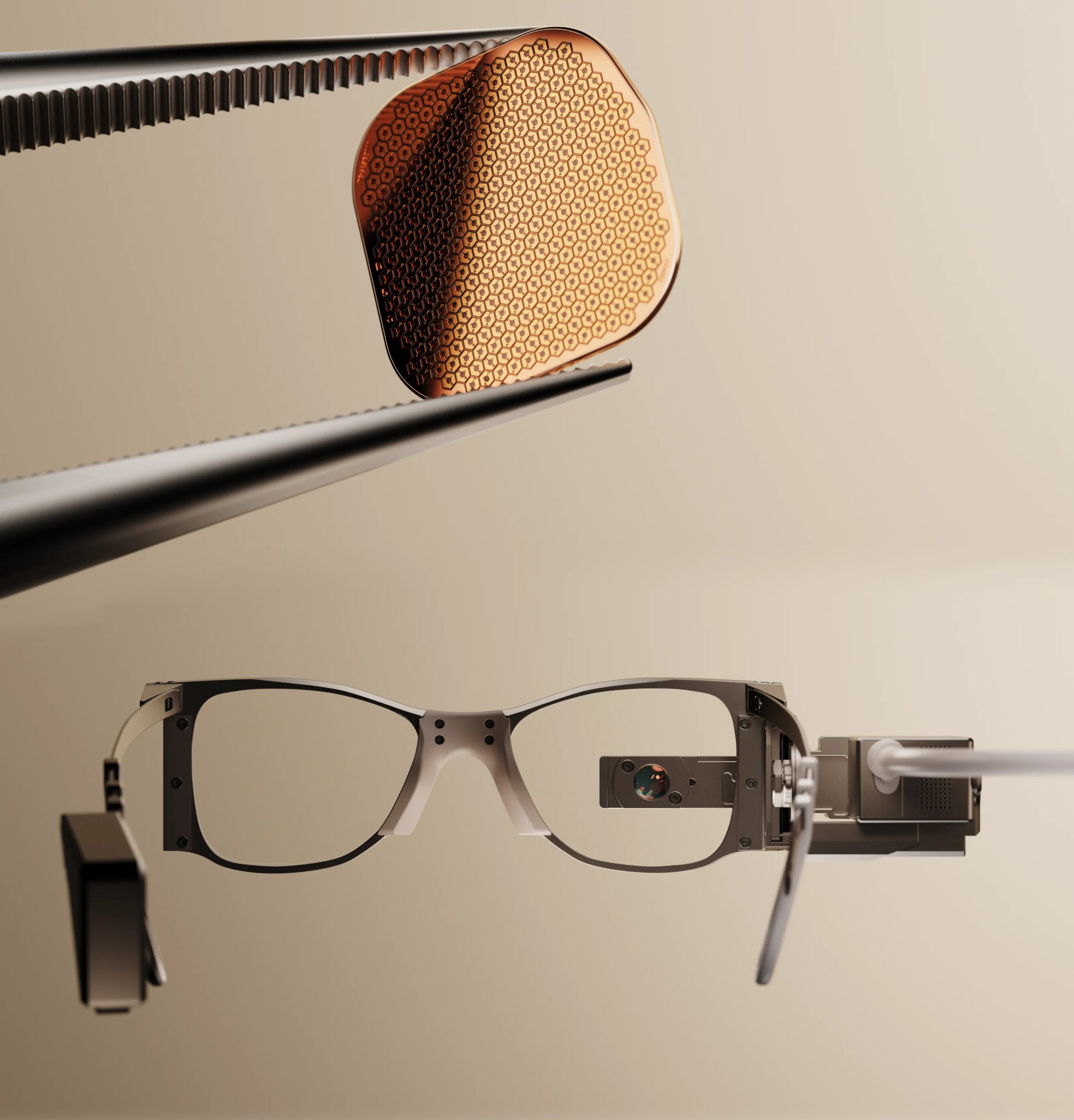
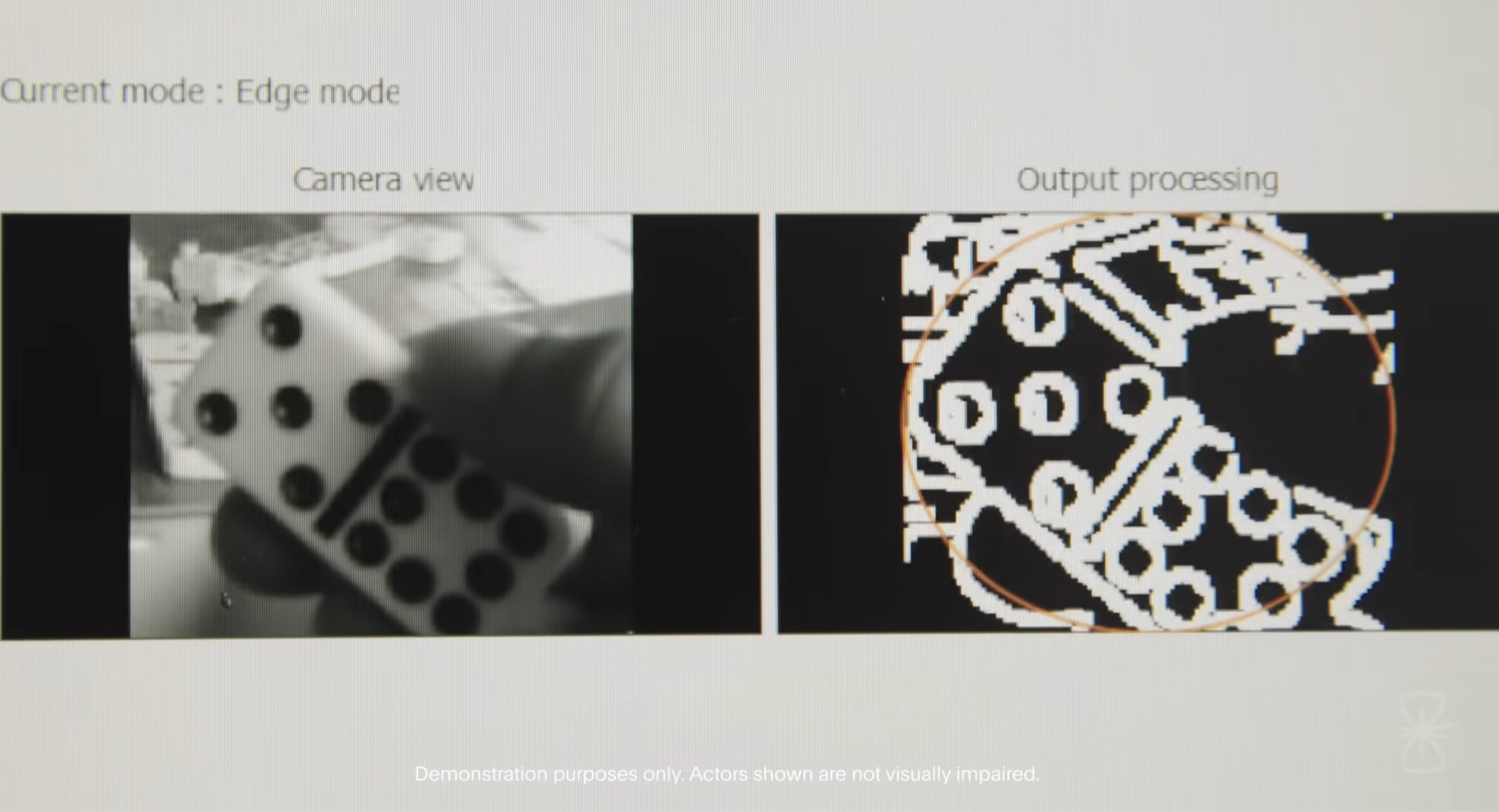
PRIMA is a novel 2 × 2 mm photovoltaic subretinal implant to be used with specialized glasses. Essentially, the device is an array of tiny solar panels with 378 light-powered pixels. The glasses, also designed by Science, project near-infrared light onto the implant, which converts it into electrical signals that stimulate the retina, bypassing dead rods and cones. A built-in zoom function allows patients to magnify letters, while the implant’s ultra-thin design enables seamless, fully wireless operation.
A clinical trial published in The New England Journal of Medicine evaluated PRIMA in 38 patients treated across 17 clinical sites in five countries. The main results were:
80% of patients demonstrated clinically meaningful improvement of visual acuity at 12 months.
84% of patients reported reading letters, numbers, and words at home with PRIMA at 12 months.
To quote a patient in the study, “Thanks to this system, I can read. I’m reading a book right now. Otherwise, I can’t do anything. It’s magical.”
As of today, PRIMA is the first BCI device to receive CE marking for form vision restoration (reading letters, numbers, and words). The company is also announcing the country-specific reimbursement applications and clinical site activations are underway across Europe. The first commercial implant of PRIMA is expected soon in Germany.
In the United States, Science is working with the Food and Drug Administration (FDA) to bring PRIMA to the US market. PRIMA has received FDA Breakthrough Device designation and Humanitarian Use Device designation.
Biohybrid and the Bridge to the Human Mind
You thought that PRIMA was the end of it?
There’s more.
What if rather than putting electronics into the brain you could put the brain, i.e. neurons, inside the electronics? This is the intuition behind Biohybrid, a neural interface technology pioneered by Science that uses living neurons to connect to the brain instead of wires, enabling orders of magnitude more bandwidth than state-of-the-art devices. Using this technology, a million embedded neurons could form a billion synapses with the brain.
The device is a tiny waffle grid sitting on the brain surface. The secret formula is optogenetics. While PRIMA uses electrodes to stimulate bipolar cells, with optogenetics you could skip the electrodes altogether and make cells light-sensitive with the help of new proteins.
But how?
The central idea is to grow the interface before placing it inside the patient.
Rather than pushing electrodes or optical fibers into the brain, you prepare the device in a dish by seeding living cells onto its surface. We’re talking hundreds of thousands of living neurons that, once implanted, extend their axons and dendrites into the surrounding brain tissue, forming countless synaptic connections with the patient’s own neurons.
In short, embedded cells act like a bridge. They speak with silicon through photons and electricity and with the brain through the same electrochemical gobbledygook used by every other neuron.
Now you got a bridge. So what?
Let’s go back to cells for a moment. Think of the cell like a fat bubble full of saline and a bunch of other molecules. Neurons are extra-special cells — they’re excitable: Proteins embedded across their membranes let them move charged particles, called ions, from one side to the other.
By controlling how these ions move, a neuron controls the voltage across its membrane. And the cool thing is, voltage can be detected.
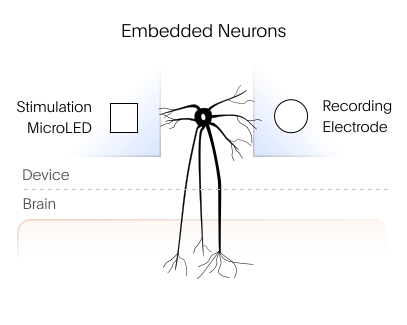
For example, if a neuron is growing directly beside an electrode and begins pumping ions across its membrane, the resulting change in the local electrical field will be picked up by the device. Science can then use a capacitive electrode to record the state of the cell.
That’s how the machine “listens” to the biological half of the interface. Talking back to it, though, is more complicated.
The conventional approach is electrical microstimulation. An electrode injects charge into the space surrounding a neuron, altering the concentration of charged particles immediately outside its membrane. Because voltage is a differential measurement between the inside and outside of the cell, changing the external electrical environment implicitly changes the membrane potential.
Consider that the voltage across the membrane is about 120 millivolts. You could modify that voltage by forcing ions through the membrane itself, but you could also change it indirectly by altering the concentration of ions outside the cell. Push the membrane potential far enough toward depolarization and the neuron fires.
This is how many neural interfaces stimulate tissue. But Science is not your everyday BCI company, and largely avoids this technique. Indeed, electrical microstimulation makes it difficult to stimulate and record at the same time. Injecting charge overwhelms the same electrodes that are supposed to detect the neuron’s much smaller signals. Not to mention that stimulation can also produce undesirable biological side effects.
So, instead of electricity, the device injects light.
That’s the magic: Before the cells are placed on the interface, Science modifies them to express a special class of light-sensitive proteins called opsins. These proteins become embedded in the neuronal membrane and act as light-gated ion channels: microscopic holes that open or close when illuminated with a particular color of light.
Science then places microLEDs alongside the electrodes in the Biohybrid device. When the system wants to activate a neuron, it switches on the LED beside it. Photons strike the opsin, the channel opens, ions move across the membrane, the cell depolarizes, and the neuron fires. The electrodes read the neurons, the LEDs write to them.
Voilà!
But there’s an issue. Recording a neural network can reveal which cells are active, but observation alone is not enough. Activation is key. By activating one or more neurons and watching what changes, researchers can finally ask questions — and more. The possibilities are endless. A specific stimulation pattern might trigger a movement, alter a decision, influence a perception — anything.
Indeed, the potential applications extend far beyond moving a cursor or decoding a simple motor command. Biohybrid could reveal how information moves through damaged neural circuits and test whether living bridges can route signals around an injury.
Early research has already examined whether optogenetic stimulation of a cortical biohybrid implant can guide goal-directed behavior. Other groups have explored organoid-brain interfaces, regenerative connections to damaged peripheral nerves, engineered axonal tracts that function as living electrodes, regenerative interfaces for neuroprosthetic limbs, biohybrid cochlear implants, and combinations of cell therapies with neural prostheses.
The sky’s the limit.
Look: Biohybrid is still a research project and so far, it’s only been tested in mice. But if (when) it finally works, it’ll be a game-changer for restoring motor functions, learning, reasoning, and speech.
It’d be like opening up the APIs of the human mind.
2035: Your Mind Melds With the Machines

The Doors famously got their name from Aldous Huxley’s 1954 book The Doors of Perception. In a quasi-Borgesian maze of references, Huxley himself took the title from a line by poet William Blake:
"If the doors of perception were cleansed, everything would appear to man as it is, Infinite.”
There, beyond the doors of day-to-day perception, at the very top of Jacob’s ladder, lies Max Hodak’s Holy Grail: consciousness engineering.
“I actually think BCI is a longevity-adjacent story,” Max says. “The brain is intelligent and it’s conscious. We know that intelligence is substrate-independent, because you get it in both brains and GPUs. But the end of the brain-computer interface quest, I think, is actually conscious machines.”
“There’s some physics that we don’t understand yet,” says Max, “And if you could understand that, then you could imagine building, say, conscious machines. You could add a third hemisphere. You could connect this over the network. This would, in some very fundamental sense, allow you to redraw the border around a brain and change where your brain ends and begins and, in that sense, where you begin and where you end.”
Wetware. The Matrix. Or, multiple identities fused together. Maybe even the Festival, from Singularity Sky.
According to Max, this might be possible within a decade.
“I think 2035 will be a very, very different world than 2025”, says Max.
Disclaimer
From Vessel and the Science Ecosystem to Science Foundry and much more, there’s a lot I didn’t mention within the limited boundaries of this article. If you’re an avid reader like I think you are, I invite you to visit Science’s beautiful website and take a look around: You won’t be disappointed.
P.S. If you like the article, please give me a helping hand: like, share, and subscribe: it’s free!
I do my best to publish once a month (once every two months tops) and bring you overlooked quasi-sci-fi news from the real world.
And if you still decide not to like and subscribe, no worries, we’re still friends and